

Massachusetts Deck Railing Codes: A Guide to Safety & Compliance
Massachusetts Deck Railing Codes: A Guide to Safety & Compliance
Building a deck in the Commonwealth of Massachusetts requires far more than an aesthetic vision; it demands rigorous adherence to the Massachusetts State Building Code (780 CMR), which is primarily modeled after the International Residential Code (IRC). For homeowners, contractors, and developers alike, the railing system is the most critical safety component of any elevated outdoor space. Whether you are installing a Trex railing system for its low-maintenance durability or its sleek, modern profile, understanding the intersection of state accessibility laws, local municipal regulations, and precision product engineering is essential.
Navigating these requirements ensures that your project not only enhances curb appeal but also passes stringent inspections and provides long-term liability protection. This guide examines the technical specifications required in Massachusetts and demonstrates how the Trex Transcend, Trex Select, and Trex Signature lines meet, and often exceed, these standards.- Massachusetts Building Codes for Residential Guardrails
In Massachusetts, the necessity of a guardrail is determined by the height of the walking surface. Any deck, porch, or balcony surface higher than 30 inches above the finished grade must be equipped with a guardrail. While the primary goal is fall prevention, the specific geometry of the railing is strictly enforced to mitigate accidents involving children and the elderly.
Guardrail Height and Structural Integrity
The 780 CMR dictates that for one- and two-family dwellings, the minimum guard height must be 36 inches. For commercial applications, public spaces, or large multi-family dwellings, this requirement often increases to 42 inches.
Structural integrity is equally paramount. A code-compliant railing must be capable of withstanding a concentrated load of 200 pounds applied in any downward or outward direction at the top of the rail. Traditional pressure-treated lumber often suffers from structural degradation, warping, checking, and fastener pull-out, over time. Trex railing systems are designed as complete kits with strong post sleeves and aluminum-reinforced rails that can hold up well for many years.
The "4-Inch Sphere" Rule and Baluster Spacing
A critical safety feature of any railing installation is the spacing of balusters or "infill." Massachusetts code requires that the spacing be tight enough that a 4-inch diameter sphere cannot pass through any point of the railing. This measurement is designed to prevent small children from slipping through or becoming dangerously lodged.
Furthermore, the gap between the bottom rail and the deck surface must also adhere to this 4-inch rule. Many industry professionals at Arlington Coal & Lumber Co. recommend aiming for a 2-inch gap. This tighter tolerance accounts for potential minor house settling and provides better clearance for debris and snow removal without compromising safety.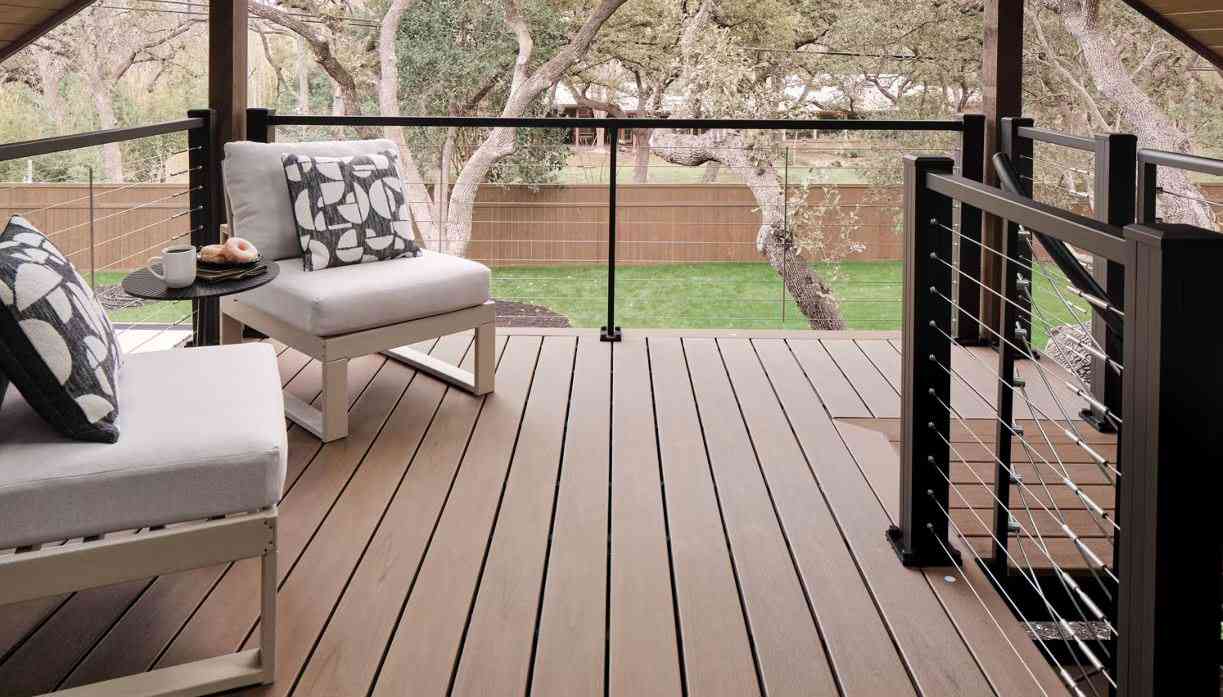
- Accessibility and ADA Compliance: Beyond the Basics
Accessibility is a vital consideration for "aging-in-place" residential designs and is a mandatory legal requirement for any commercial or public-facing project. The Americans with Disabilities Act (ADA) and the Massachusetts Architectural Access Board (MAAB) provide specific guidelines that distinguish between "guards" (designed to prevent falls) and "handrails" (designed for grasping).
Graspability and Ergonomic Profiles
While a standard 2x4 wood top rail or a wide Trex Transcend crown rail provides a classic aesthetic, they are not considered "graspable" by ADA standards. For stairs and ramps, the code requires a secondary handrail that a user can fully wrap their fingers around to maintain balance.
The Trex Signature line is frequently the solution of choice for these applications. Its slim, powder-coated aluminum profile is inherently more ergonomic. Trex also offers specialized ADA-compliant aluminum handrail components that can be seamlessly integrated into any composite railing system. These components feature the following:- Circular Cross-sections: Typically 1.25 to 1.5 inches in diameter for an easy grip.
- Continuous Paths: Handrails must be uninterrupted for the full length of a stair flight or ramp.
- Returned Ends: Railing ends must "return" or turn back into a wall or post to prevent catching sleeves, straps, or bags.
- Comparing Trex Railing Lines for Code Compliance
Choosing the right product involves balancing the architectural style of a Massachusetts home with the specific functional requirements of the site. Trex offers three distinct tiers, each engineered for safety.
Trex Transcend: The Gold Standard for Customization
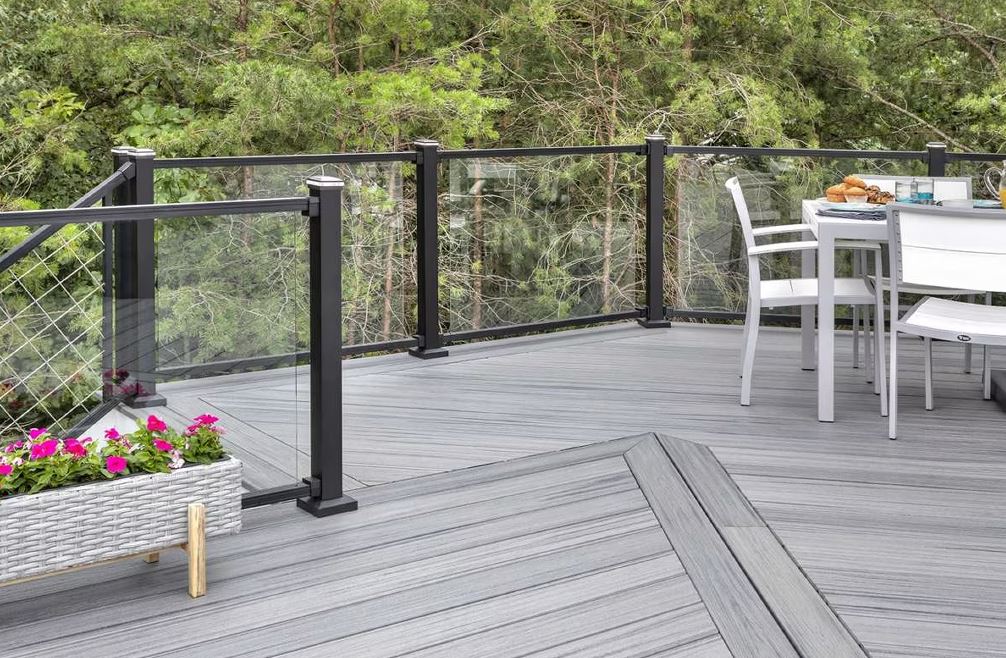
Trex Transcend is the premier choice for high-end residential projects. It features a deep wood-grain pattern and a robust "crown" top rail profile. Because it utilizes a composite-over-aluminum or composite-over-wood architecture, it offers immense rigidity. Transcend provides the widest variety of infill options, including square composite balusters, round aluminum balusters, and glass slats, all of which are designed to maintain the necessary 4-inch spacing requirements while offering a luxury finish.
Trex Select: Streamlined Performance
For builders seeking a traditional look with a simplified installation process, Trex Select is an ideal, cost-effective solution. It typically features a white "classic" rail paired with round charcoal black aluminum balusters. This system is pre-drilled and engineered for efficiency, ensuring that baluster spacing is automatically code-compliant without the need for painstaking manual measurements on-site.
Trex Signature: Modern Strength and Maximum Visibility
Trex Signature is a premium powder-coated aluminum system. It is particularly valued in coastal Massachusetts (such as the North Shore or Cape Cod) or for homes with scenic views, as the thin profiles provide maximum visibility. Aluminum is inherently stronger than wood or pure composite, allowing for longer spans, up to 8 feet, between posts while still meeting the 200-pound lateral load requirement. This reduces the number of post installations, lowering labor costs while maintaining an ultra-modern, high-security profile.
- Technical Precision: Stairs and Ramps
The transition from a flat deck to a staircase is where many DIY projects fail inspection. In Massachusetts, stair railings must meet specific geometric criteria:- Uniform Height: The guardrail height must be consistent, measured vertically from the "nosing" (the leading edge) of the stair tread.
- The Triangular Gap Rule: The triangular area formed by the stair riser, the tread, and the bottom rail must be small enough that a 6-inch sphere cannot pass through.
- Stair Width: Residential stairs generally require a minimum clear width of 36 inches. Railing hardware must not encroach more than 4.5 inches into this width on either side.
Using Trex stair kits simplifies this complex geometry. These kits provide "stair adapters" or articulated brackets that accommodate standard stair angles (typically 32 to 37 degrees), ensuring that the vertical balusters remain perfectly plumb while the rails follow the pitch of the stairs precisely.- Expert Insights: Maintaining Compliance in New England Climates
Code compliance is not merely a "day-one" requirement; it is a commitment to the lifespan of the structure. Massachusetts weather, characterized by heavy snow loads, high humidity, and salt air, is notoriously punishing on building materials.
Corrosion Resistance and Structural Longevity
Traditional wood railings are susceptible to rot, and their fasteners can corrode, silently compromising the 200-pound load capacity. Trex Signature aluminum and the high-performance shells of Transcend and Select are impervious to rot, warping, and wood-boring insects. This ensures that the railing remains as safe in year twenty as it was on day one.
Managing Thermal Expansion
All composite materials expand and contract with temperature fluctuations. Trex systems are engineered with specialized bracket tolerances that allow for this movement without buckling the rails or loosening the fasteners, a common cause of railing failure and "wobble" in older, traditional decks.
Critical Fastener Selection
A railing is only as strong as its connection to the deck frame. Simply screwing a post into the decking boards is a major code violation and a safety hazard. Arlington Coal & Lumber Co. recommends using deck screws and internal post mounts, or through-bolting the posts directly to the rim joists to ensure the assembly can withstand significant lateral pressure.- Partnering with Arlington Coal & Lumber Co.
Ensuring your railing meets local Massachusetts regulations is a non-negotiable aspect of responsible building. By selecting a high-performance system like Trex, you are investing in a product that has been laboratory-tested to meet the most stringent IRC and ADA requirements.
At Arlington Coal & Lumber Co., we specialize in providing the highest quality building materials to the New England community. From the foundational structural lumber and pressure-treated framing to the final aesthetic touches of Trex deck railing, premium windows, and siding, we offer the expertise and inventory to ensure your project is successful, compliant, and built to last.
Ready to start your next project? Contact our team of experts today to discuss your deck design and ensure your railing system meets all local safety codes. We proudly serve professionals and homeowners in Arlington, Wilmington, Burlington, Sudbury, and Chelmsford, MA.