

DIY vs. Professional Deck Railing Installation in Massachusetts
DIY vs. Professional Deck Railing Installation in Massachusetts
An outdoor deck is more than just a structural extension of a home; it serves as a central hub for weekend barbecues, a private retreat for morning coffee, and a high-visibility architectural element that defines a property’s curb appeal. In Massachusetts, where the coastal climate and dramatic seasonal shifts bring everything from blistering summer humidity to heavy winter snow, constructing a deck that is both aesthetically striking and structurally resilient is paramount.
When planning a comprehensive deck upgrade or a new build, one of the most critical decisions a property owner or project manager faces is whether to tackle the railing installation as a do-it-yourself (DIY) project or hire a seasoned professional.
The railing system is far more than an aesthetic frame for an outdoor living space; it is a vital engineered safety barrier. Selecting the right materials, such as high-performance, low-maintenance composite and aluminum systems, and deciding on the deployment method will fundamentally impact your project’s budget, timeline, and long-term durability. This comprehensive thought-leadership guide breaks down the critical considerations for DIY versus professional installation, examines the unique structural challenges imposed by the New England climate, and explores how different premium product lines fit into your technical project planning.
Understanding the Stakes: Safety, Codes, and the Massachusetts Climate
Before picking up a miter saw or signing a contractor agreement, it is crucial to recognize that railing installation is a highly regulated aspect of residential and commercial construction. Unlike building a simple garden landscape feature, an improperly installed deck railing poses a severe structural liability and safety hazard.
Massachusetts Building Code Compliance
The Massachusetts State Building Code (780 CMR) enforces strict, non-negotiable regulations regarding guardrails. For any deck elevated more than 30 inches above the adjacent grade, a protective guardrail system is legally required. Industry professionals and DIYers must adhere to several precise metrics:- Height Requirements: Residential railings must stand at least 36 inches high, measured vertically from the finished decking surface to the top of the upper rail. Commercial applications often demand a 42-inch height.
- Baluster Spacing: The spacing between balusters, glass panels, or cable infill must be narrow enough that a 4-inch sphere cannot pass through at any point. This infill restriction is a critical safety measure designed to prevent small children from slipping through.
- Load Capabilities: Guardrails must be engineered to withstand a concentrated load of 200 pounds applied in any outward or downward direction at any point along the top rail.
The Impact of New England Weather
Massachusetts properties face exceptionally harsh environmental stressors that present specific regional challenges:- Coastal Zone Stressors: Waterfront and nearby inland communities are subjected to high salt spray, brackish moisture, elevated humidity, and intense wind loads.
- Inland Environmental Shifts: Inland regions endure severe freeze-thaw cycles, sub-zero temperatures, and heavy winter snow accumulation.
- Weaknesses of Traditional Wood Railings: Standard lumber profiles are very sensitive to these changing conditions. They often warp, rot, check, and split, which means they need to be sanded, painted, or stained every year to keep from failing.
- Using advanced synthetic and composite materials eliminates maintenance issues, but it requires careful spacing because these materials expand and contract with temperature changes.
The DIY Route: Handyman Freedom vs. Hidden Costs
The rise of fully engineered railing kits, pre-routed posts, and drop-in bracket systems has made DIY installation more accessible than ever. For a property owner or enthusiast with intermediate to advanced carpentry experience, taking on a premium railing installation can be a viable path.
Advantages of DIY Installation- Direct Labor Savings: The most apparent benefit of a do-it-yourself project is the elimination of professional labor fees. Because installation labor can account for a significant portion of a remodeling budget, pocketing those savings allows you to reallocate capital toward premium material lines or upgraded lighting options.
- Complete Schedule Control: Operating as your own general contractor eliminates reliance on a production company's multi-week backlog. You can execute the work at your preferred pace, whether that means pulling consecutive full days over a weekend or chipping away at the installation during weekday evenings.
- Personal Satisfaction: There is an undeniable sense of pride that comes from standing on a finished deck, looking across a flawless perimeter of modern railing, and knowing it was executed with your hands.
While the benefits are attractive, the hidden logistical friction can quickly overwhelm an unprepared installer.- Specialized Tool Investments: Standard household tools are rarely sufficient for high-performance materials. To install a composite or aluminum system cleanly without voiding product warranties, you require a compound miter saw equipped with high-quality, high-tooth-count carbide-tipped blades, an impact driver, a hammer drill for post-mounting on concrete or specific structural framing, specialized tensioning tools for cable infills, and high-precision leveling instruments. Purchasing or renting this equipment quickly erodes estimated labor savings.
- The Zero-Tolerance Margin for Error: Composite and aluminum components are premium products with no margin for error. Making an incorrect cut on a high-end top rail means entirely ruining an expensive piece of engineered material. Unlike traditional lumber, you cannot patch a misplaced screw hole or a chipped cut in a dark composite post sleeve with wood filler and paint.
- Extended Time Commitment: A project that a professional, multi-man crew can finish in a single afternoon might easily take an unassisted or under-equipped homeowner two to three full weekends to complete, especially when factoring in the inevitable multiple trips back to the building material supplier for forgotten hardware or replacement components.
The Professional Route: Expertise, Efficiency, and Asset Protection
For many property managers, custom home builders, and busy homeowners, outsourcing the installation to a dedicated, licensed contractor is the preferred route. Shifting the logistical, structural, and regulatory burden to professional installers guarantees a precise finish.
Advantages of Professional Installation- Professional contractors ensure that all building permits are obtained, work directly with town inspectors, and know how to strengthen the deck properly's rim joists and structural framing with blocking and tension ties to meet or exceed the 200-pound lateral load requirement.
- Immaculate Fit and Finish: Experienced installers repeat this process daily. They understand how to handle complex field geometry, such as non-90-degree angles, multi-level transitions, and stair railing rakes where mathematical precision is mandatory. The result is perfectly aligned sightlines, tight joints, and clean aesthetics.
- Advanced Warranty Protection: While top-tier brands offer exceptional manufacturer warranties on their physical materials (often spanning 20 to 25 years), these warranties carry strict stipulations regarding proper installation according to exact specification manuals. If a DIYer installs a product incorrectly, such as using improper fasteners or violating clear span rules, the manufacturer's warranty may be voided. Professional installation protects your long-term investment, and reputable contractors provide an additional labor warranty on top of the product coverage.
- Speed of Execution: A professional crew operates as a highly coordinated asset. What takes an individual weeks of trial and error can be completed by an expert team in a matter of hours, minimizing operational disruption to your home and outdoor living space.
- Higher Upfront Capital Investment: Premium craftsmanship requires a higher upfront financial commitment. Labor costs reflect the contractor’s insurance, licensing, specialized equipment, and expertise, which can equal or sometimes exceed the baseline raw material costs depending on the layout's complexity.
- Scheduling and Availability Realities: High-quality contractors in the New England region stay heavily booked, particularly during the peak spring and summer building seasons. You may have to plan well in advance and wait weeks or months for an elite crew to open up a slot in their production schedule.
Whether you ultimately choose to install the system yourself or hire a professional, selecting the right material system is a critical step. The modern product marketplace is tiered to accommodate various architectural styles, environmental demands, and installation skill sets.- Accessible Composite Options
For projects leaning toward a DIY approach with a focus on value and classic style, entry-level composite options provide an ideal starting point. These systems frequently utilize a clean, white composite rail structure contrasted with round black aluminum balusters, delivering a timeless look that complements traditional architecture.- DIY Suitability: High. These systems are engineered intentionally for straightforward assembly, utilizing intuitive component kits, drop-in brackets, and pre-routed paths that are easy to master with standard power tools.
- Key Features: Delivers the core structural advantages of high-performance composites, such as absolute resistance to rot, warping, and splintering, at an accessible price point. It is optimized for straightforward, clean deck geometries.
- Maintenance Profile: Requires zero painting, staining, or sealing. Maintenance is limited to basic periodic washing with soap and water to clear seasonal environmental dust.
- Luxury Composite Systems
For homeowners and design-build firms looking to make a bold architectural statement, luxury composite lines represent the peak of custom flexibility. Featuring deep, historic crown-rail profiles, multiple rich color ways (including authentic wood-grain aesthetics), and highly customizable infill options, these lines allow for bespoke designs.
- DIY Suitability: Moderate. Because of its modular nature, installers must mix, match, and independently calculate counts for posts, multi-piece rails, and custom infills. This complexity demands highly disciplined planning, immaculate math, and elevated carpentry skills.
- Key Features: Boasts an ultra-thick, resilient outer shell that shrugs off heavy foot traffic, scratches, stains, and UV fading. Backed by extensive residential warranties, it represents a premium solution for luxury outdoor living environments.
- Maintenance Profile: Highly resistant to color fading and chemical stains. Does not require sanding or refinishing over its multi-decade lifespan.
- Sleek Modern Aluminum
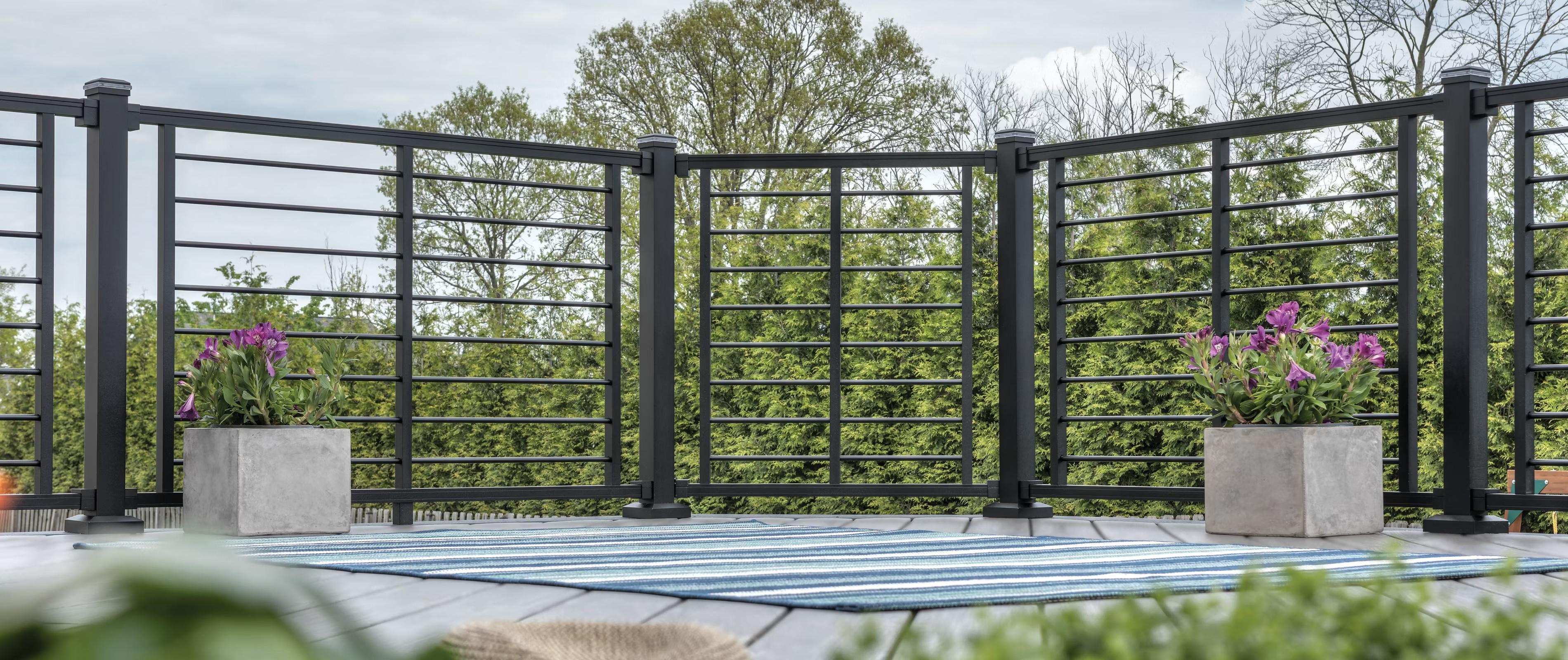
Premium-grade aluminum is the definitive choice if a property features modern architectural design or aims to preserve an unobstructed view of the surrounding New England landscape. Engineered with slim profiles and exceptional structural strength, aluminum creates a minimal footprint.- DIY Suitability: Moderate to Low. While manufacturers offer pre-assembled welded panels to streamline field assembly, working with high-grade aluminum requires specialized non-ferrous metal cutting blades, exact measurements, and a highly steady hand. If advanced infill options like horizontal stainless steel rods or architectural mesh inserts are selected, professional installation is strongly recommended.
- Key Features: Exceptional mechanical strength paired with low weight. Provides thin, rigid vertical or horizontal balusters that preserve expansive landscape sightlines.
- Maintenance Profile: Entirely powder-coated to prevent oxidized corrosion, paint peeling, or rust, making it an ideal choice for both coastal applications and minimalist urban designs.
Decision Matrix: Should You DIY or Hire a Professional?
To clarify your project pipeline, review the following checklist. If your resources and project parameters align primarily with the DIY criteria, you are well-positioned to tackle the installation yourself. If your project matches the professional criteria, partnering with an expert contractor is the recommended path forward.
Choose DIY If:- You own, or are fully prepared to invest in, a dedicated suite of precision power tools (miter saw, digital levels, and impact drivers) and maintain documented experience operating them safely.
- Your deck footprint is a straightforward geometric shape (rectangle or square) with no complex angles, multi-level platforms, or irregular stair configurations.
- Your project timeline is highly flexible, and you have no objection to your outdoor space remaining a semi-active construction zone over several weeks.
- You have access to a reliable and capable assistant, as safely managing, leveling, and fastening long railing spans requires the help of two people.
- Your deck features intricate architectural curves, octagonal projections, multi-level step-downs, or steep, complex stairways requiring custom cut angles.
- You want sophisticated modern design integrations, such as low-voltage post-cap LED lighting, hidden wiring harnesses, or advanced rod-rail infills.
- You prefer not to handle local permitting offices, structural engineering calculations, or zoning compliance inspections yourself.
- Your schedule is restricted, and you require the project executed efficiently, cleanly, and backed by a binding structural labor warranty.
No matter which path you select, the ultimate success of your construction project hinges on sourcing high-performance materials and securing accurate technical guidance. A seamless installation begins long before the first fastener is driven; it starts in the take-off and estimating phase.
A dedicated local building supply expert ensures accurate calculation of your material list. An incomplete order, missing a single specific pack of specialized brackets, post-skirt trims, or structural screws, can halt an entire project mid-weekend, causing frustrating delays.
For the dedicated DIYer, an expert building material supplier provides more than just product; they offer crucial installation insights, component diagrams, and tailored material lists calculated directly from your deck drawings. For commercial contractors and custom builders, a trustworthy supplier is a vital part of their business, offering a strong supply chain, quick and reliable delivery to job sites using boom trucks, and priority access to high-quality composite and aluminum materials. This partnership ensures that your jobs remain strictly on schedule, within budget, and built to stand the test of time.
Take the Next Step in Your Railing Journey
Upgrading your architectural railing is a definitive investment in the structural integrity, safety compliance, and long-term valuation of your property. If you possess the tools, physical assistance, and advanced carpentry background, embarking on a DIY installation with an accessible system can be a highly rewarding project. But if your design requires complicated shapes, tricky stair layouts, built-in low-voltage lighting, or the guaranteed safety of following building codes and having labor warranties, working with a licensed professional contractor is the best choice.
Are you ready to transform your outdoor living space with premium, low-maintenance decking and railing systems engineered for the New England climate? Whether you are a homeowner mapping out a refined weekend project or a licensed commercial contractor seeking the highest quality lumber, insulation, windows, and structural building materials in Massachusetts, securing an elite supply chain is paramount.
Partner with the region's trusted industry experts today. Contact or visit Arlington Coal & Lumber to consult our product specialists, explore our comprehensive commercial inventory, and secure the advanced materials or trusted professional recommendations required to bring your structural vision to life. We proudly serve building professionals and homeowners across our accessible locations in Arlington, Wilmington, Burlington, Sudbury, Hudson, and Chelmsford, Massachusetts.
