

Tracing the Evolution of Windows from Antiquity to Modern Massachusetts
The Glass Canvas: Tracing the Evolution of Windows from Antiquity to Modern Massachusetts
Windows are often described as the "eyes of a building," yet their history is less about looking out and more about the human struggle to let light in while keeping the elements at bay. This evolution is a masterclass in engineering, shifting from primitive holes in the wall to high-tech thermal barriers. By tracing this journey from ancient Rome through the specific architectural heritage of Massachusetts, we can see how centuries of innovation paved the way for the high-performance windows we rely on today.
Ancient Origins: The Unfilled Opening
In the earliest stages of human architecture, a window was not an object, but a void an absence of material. The word "window" originates from the Old Norse vindauga, a compound of vindr (wind) and auga (eye). This "wind-eye" was a literal description of its function: a hole in the masonry or timber to allow smoke to escape and fresh air to enter.
In ancient Mesopotamia and Egypt, openings were strategically placed high in the walls to maintain privacy and security while allowing sunlight to filter in. In the Mediterranean, these were often narrow slits, sometimes covered with animal hides, cloth, or wooden shutters. It was the Romans who revolutionized the concept around 100 AD. They were the first to use glass for windows, though it was a far cry from the clarity we enjoy today. "Roman glass" was thick, greenish, and translucent, produced by blowing glass into a cylinder and flattening it. These early panes provided light and protection from the wind but offered little in the way of a view.
The Middle Ages: Fortification and Faith
Following the collapse of the Roman Empire, the art of glassmaking largely retreated into the shadows of Europe. During the Early Middle Ages, windows returned to being functional necessities for defense rather than comfort.
The Romanesque Period
Architectural styles reflected a societal need for security. Thick stone walls featured narrow, arched windows known as "loopholes" or "arrow slits." These allowed defenders to fire projectiles while remaining protected. Because glass was prohibitively expensive and rare, these openings were often covered with translucent horn, oiled paper, or linen soaked in tallow to make it water-resistant.
The Gothic Revolution
By the 12th century, the architectural landscape shifted. The invention of the flying buttress allowed walls to become thinner and taller, as they no longer needed to bear the full weight of the roof. This paved the way for the massive, soaring windows of Gothic cathedrals. Since large sheets of clear glass were still impossible to manufacture, artisans joined small pieces of colored glass with lead strips (cames). This created the iconic stained glass that served as "the Bible of the poor," illustrating religious stories for a largely illiterate population.
The New World Frontier: Post-Medieval Massachusetts (1625–1725)
As English settlers arrived in Massachusetts, they brought these medieval sensibilities to a much harsher climate. In early settlements like Salem and Ipswich, windows were built for survival against the "Little Ice Age" of the 17th century.
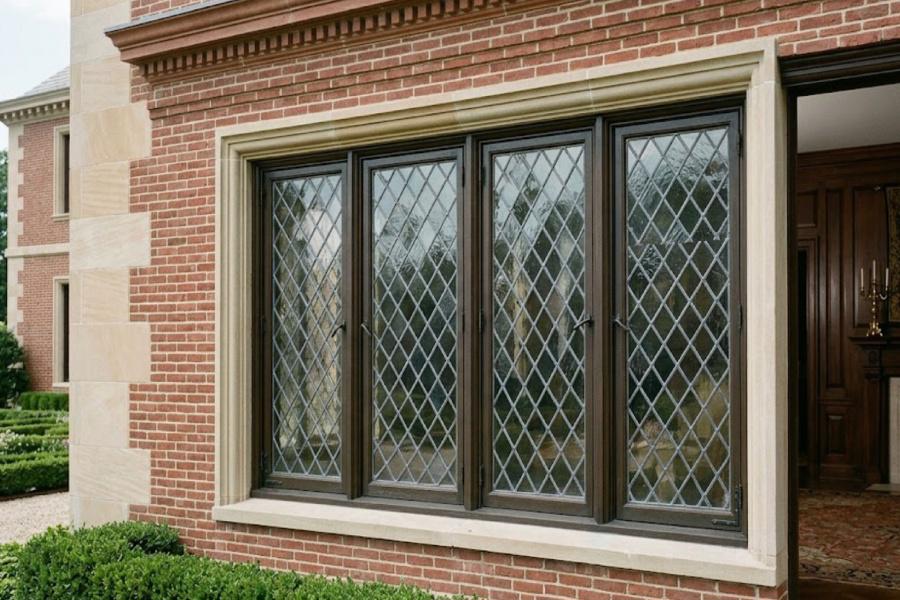
- Diamond-Paned Casements: Early "First Period" homes featured tiny, diamond-shaped panes called quarrels. These were held together by flexible lead strips because the technology to create large, flat sheets of glass did not yet exist in the colonies. Glass was a precious imported commodity, often taxed heavily or salvaged from older ships.
- Thermal Defense: These windows were intentionally small and asymmetrical. They were placed based on internal utility such as near a kitchen hearth or a spinning wheel rather than for external beauty. The goal was to minimize the "breach" in the wall's insulation, as New England winters were far more brutal than those in the settlers' native Britain.
- The Palladian Window: This became a hallmark of Massachusetts high society. It featured a large central arched window flanked by two smaller rectangular windows.
- Fanlights: Above front doors, semi-elliptical "fanlights" with intricate lead or wood tracery became common, turning the window into a piece of decorative art that welcomed light into the grand entryways of Salem’s merchant mansions.
- Greek Revival: In the Massachusetts countryside, "temple-front" homes adopted larger versions of the six-over-six sash, reflecting the democratic ideals of the young nation through bold, white-painted frames.
- The Victorian "Two-over-Two": As glass became cheaper and stronger, the need for many small panes vanished. Victorians favored large, heavy sheets of glass. In the narrow streets of Boston’s Back Bay, the Bay Window became a staple. These were not merely aesthetic; they were designed to "reach out" into the street to capture the sun as it moved across the narrow urban sky, providing much-needed light to deep row houses.
The Modernist Movement: The Ribbon Window
In the early 20th century, the "International Style" redefined the window's structural role. Architects like Le Corbusier argued that windows should no longer be holes in a wall, but continuous bands. The introduction of steel frames allowed for "ribbon windows" that wrapped around corners. This era transitioned the window from a framed picture of the outside world into a "curtain wall," where the entire facade of a building could be made of glass, fundamentally changing the relationship between private indoor space and the public outdoor world.
The Evolution Toward Modern Performance
The windows we install today are the culmination of this 2,000-year journey. We have moved from seeking mere light to seeking thermal intelligence. Before the 1970s energy crisis, single-pane windows were the standard. Today, windows are complex "Insulated Glass Units" (IGUs).
The High-Tech "Sandwich"
Modern windows are engineered layers of materials designed to combat New England’s temperature swings:
- Multiple Panes: Double or triple glazing creates stagnant air pockets that act as a thermal break.
- Low-E (Low-Emissivity) Coatings: A microscopic metal layer is applied to the glass. It reflects infrared light (heat) back into the room during winter while reflecting solar heat away in the summer.
- Inert Gas Fills: Argon or Krypton gas is pumped between the panes. Because these gases are denser than air, they drastically slow down the transfer of heat through the window.
